If you have ever asked how much does link building cost, you are not alone. It is one of the first questions small-business owners ask when they start thinking seriously about search engine optimisation, and it is also one of the hardest to answer with a single number. Link building is not a product with a fixed price tag. It is skilled, time-consuming work, and the price depends on who does it, how they do it, and how strong the links are. This guide explains, in plain language, what link building is, what it typically costs in the market in 2026, what makes one quote very different from another, and how to judge whether a quote is fair. It is written for owners of small businesses in the United States, the United Kingdom and Germany, with notes for owners in Pakistan as well. You will find no price for Links Optimizer Pro in this article, because the agency does not publish fixed rates. What you will find is the information you need to budget sensibly and to ask the right questions before you spend anything.
How Much Does Link Building Cost? The Short Answer
How much does link building cost in 2026? In broad market terms, a single quality link placed through genuine outreach commonly costs somewhere in the low hundreds of US dollars when bought as part of a campaign, while a managed monthly link building service commonly costs from around $1,000 to $5,000 or more per month for a small business, depending on volume, authority and the amount of content involved. Very small, one-off efforts can cost less, and large, competitive campaigns can cost far more. Those ranges are not quotes. They are a starting point for understanding the market, drawn from the public pricing surveys and agency guides discussed below. The rest of this guide explains why the range is so wide, and why the cheapest option is rarely the best value.
Think of it this way. A link is a recommendation from one website to another. A recommendation from a well-known, trusted website in your own industry is worth far more than a mention on a website nobody visits. Earning the first kind takes research, good content and personal outreach. Earning the second kind takes very little effort at all. Price usually follows effort and quality, which is why two offers that both promise “10 links” can be completely different things.
What Link Building Is, and Why It Costs What It Does
Link building means earning hyperlinks from other websites to pages on your website. When a reputable site links to you, search engines treat that link as a vote of confidence. Enough relevant, trustworthy votes, combined with useful content and a sound website, help a page rank higher in search results. That higher visibility can bring visitors who were already looking for what you sell.
Good link building is labour-intensive. A typical campaign involves choosing the right pages to promote, researching websites that genuinely fit your topic, finding the right contact, writing a pitch that is useful to that site and its readers, often creating or improving content worth linking to, following up politely, and then checking that the link is live, relevant and correctly placed. None of that happens in five minutes. A single placement can involve hours of work spread over days or weeks, and many pitches receive no reply at all. You are paying, in large part, for that skilled time and for the relationships and judgement that make pitches succeed.
There is also a second, very different kind of “link building” in the market: buying links in bulk from link sellers, using automated tools, or placing links on low-quality sites that exist mainly to sell links. That work is cheap because it is fast and requires little skill. It is also risky, as explained later in this guide. When you compare prices, always ask what work is actually being done. A low price for a very different service is not a bargain.
Why links still matter in 2026
Search engines have become much better at understanding content, and links are not the only ranking factor. A fast, well-structured website and genuinely helpful content matter enormously. Even so, links remain one of the strongest signals that other people find a page useful enough to recommend. For a small business competing against larger companies, a small number of relevant, authoritative links can make the difference between a page that sits on page three and a page that customers actually find. That is why link building remains a normal part of SEO services for many businesses, rather than a separate trick.
What the Market Charges: Per-Link, Retainer and Project Pricing
Public surveys of agencies, freelancers and link building providers give a useful picture of the market, even though no two providers charge in exactly the same way. The figures below summarise the ranges most often reported in public sources in recent years, updated for 2026 planning. Treat them as market ranges, not as promises, and remember that currency, industry and competition all move the final figure.
Per-link pricing
Some providers charge per link placed. In public agency surveys, the cost of a single link earned through outreach is often reported in the range of roughly $100 to $500, with links on higher-authority, highly relevant sites costing more, sometimes $500 to $1,000 or beyond. Guest post placements, where a provider writes an article for another site that includes a link back to you, often sit in a similar range once writing and placement are included. At the other end of the market, links sold for $5, $10 or $20 almost always come from low-quality sites, link farms or automated networks. The price tells you something important about the quality on offer.
Monthly retainers
Many agencies sell link building as part of a monthly retainer. For small businesses, publicly reported monthly retainers for link building and related SEO work commonly start at around $1,000 to $2,000 per month for a modest campaign, with $2,500 to $5,000 per month common for a more active campaign in a competitive industry. Larger campaigns, or campaigns in very competitive sectors such as finance, legal services or insurance, can run to $10,000 per month or more. A retainer usually buys a set amount of outreach, content and reporting each month, rather than a guaranteed number of links, because no honest provider can guarantee that a particular website will agree to link.
One-off projects and hourly rates
Some businesses prefer a one-off project, such as a digital PR campaign, a piece of research or a guide that is promoted to earn links over a few weeks. Project prices vary widely with scope, but a small, well-targeted project often costs a few thousand dollars. Freelance link builders and consultants, where they charge by the hour, commonly report rates in the range of roughly $50 to $150 per hour, with experienced specialists charging more. Hourly work suits audits, strategy and training. Ongoing outreach usually works better on a retainer or per-project basis, where the focus stays on results rather than hours logged.

What Affects the Price of Link Building?
Seven factors explain most of the difference between a cheap quote and an expensive one. Understanding them helps you compare quotes fairly, instead of comparing only the headline number.
1. Authority of the linking website
A link from a strong, well-known website in your field is harder to earn and more valuable than a link from a new or little-visited site. Providers often use authority scores, such as Domain Rating or Domain Authority, as a rough guide. Those scores are useful shorthand, but they are not the whole story. A moderately scoring site that is genuinely relevant to your business can be worth more than a high-scoring general site with no connection to what you do. Expect to pay more for placements on stronger sites, and be wary of any provider who promises only high-authority links at a very low price.
2. Relevance to your business
Relevance is about fit. A link from a plumbing blog to a plumber makes sense. A link from a plumbing blog to a fashion shop does not, and search engines are increasingly good at spotting that mismatch. Relevant outreach takes longer, because the provider must find sites that truly fit, understand their audience, and pitch something those readers will value. Irrelevant links are easy to place in bulk, which is one reason they are cheap.
3. Outreach versus paid placements
Earned outreach, where a site links because the content is genuinely useful, is slower and usually more expensive than a paid placement, where a fee is paid to a site owner or intermediary. Paid placements are not automatically bad, but they carry rules and risks. Google’s guidance is clear that links intended to manipulate rankings, including links bought or sold for that purpose, can be treated as link spam. You can read Google’s own explanation in its documentation on link spam. A trustworthy provider will explain which approach they use, how they disclose paid placements where required, and how they keep your site on the safe side of that guidance.
4. Content: who writes it, and how good it is
Many links are earned because the linked page is worth linking to. That may mean a helpful guide, original research, a useful tool or a well-written guest article. Creating that content costs money, and good content costs more than thin, generic text. If a quote includes content creation, check who writes it, whether you can review it, and whether it is written for readers first. If a quote does not include content at all, ask what will be pitched to other sites, and whether your existing pages are strong enough to earn links on their own.
5. Your industry and how competitive it is
Link building in a quiet niche, where few competitors are actively seeking links, is usually cheaper than link building in a crowded market where every competitor has an agency working for them. Competitive industries also tend to have higher expectations from site owners, who receive many pitches and choose only the best. Your location matters too. Campaigns targeting the United States or the United Kingdom often cost more than campaigns targeting less competitive markets, because outreach, content and placement costs are higher there. In Pakistan, for example, local outreach and content costs may be lower, but links from strong international sites will still be priced at international market rates.
6. Volume and speed
More links, faster, costs more. It also carries more risk if done badly. A natural link profile grows steadily over time. A sudden flood of links from unrelated sites looks unnatural and can attract attention for the wrong reasons. A good provider will set a realistic pace, often a handful of quality placements per month for a small business, rather than promising dozens of links in the first week.
7. Reporting, tools and account management
Behind every campaign there are tools for finding prospects, checking link quality, tracking placements and monitoring whether links stay live. There is also the time spent reporting to you and adjusting the strategy. Those costs are real, and they are part of why a managed service costs more than a list of links bought from a marketplace. Ask what reporting you will receive, and how often, before you agree to anything.

What a Good Link Building Service Should Include
A good service is transparent from the start. Before you pay, you should understand the strategy, the kind of sites being targeted, the content involved, the expected pace, and how success will be measured. During the campaign, you should receive regular, honest reporting. After a placement, you should be able to see the link for yourself.
- A clear strategy tied to your business goals. Which pages matter most, which keywords and topics you are targeting, and why those sites are the right fit.
- Manual, personalised outreach. Real pitches to real site owners, tailored to each site, not mass-mailed templates sent to thousands of addresses.
- Quality content. Pages worth linking to, and guest content that is genuinely useful to the host site’s readers.
- Relevant, reputable placements. Links from sites that are real, active and topically connected to your business, with sensible anchor text that reads naturally.
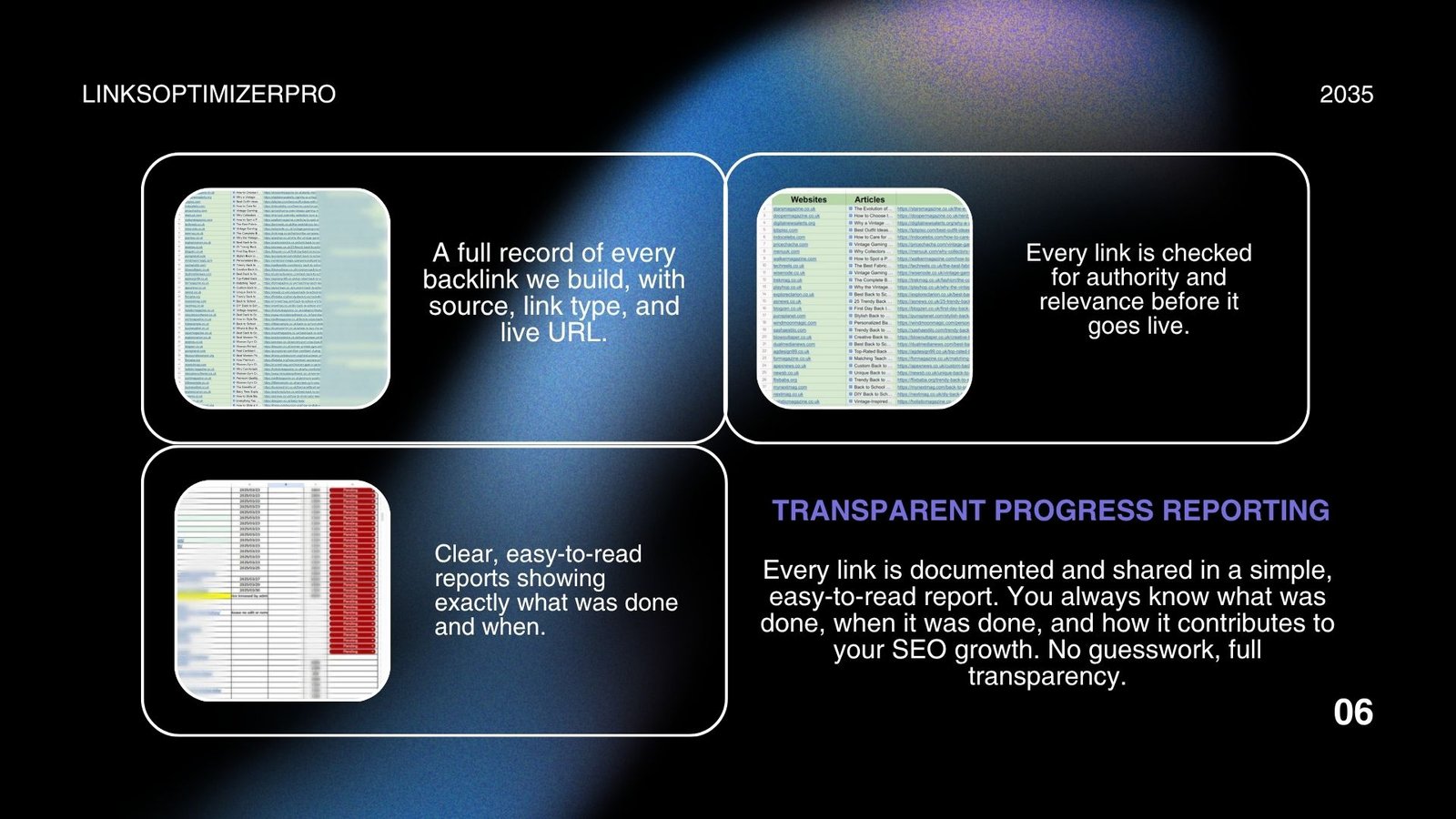
- Full reporting. A live link list showing each placement, the linking page, the date it went live, and whether it is still live. You should never have to take the number of links on trust.
- Honest expectations. No guarantee of a specific ranking, a specific number of links from named sites, or a result in an unrealistic time frame. Outreach depends on other people saying yes.
- Safe practices. An approach that follows Google’s guidance, avoids link schemes, and protects your site’s reputation for the long term.
Link building rarely works best in isolation. It works best when the pages being linked to are genuinely helpful, the website is technically sound, and the business has a clear offer. That is why many owners buy link building as part of a wider plan that also covers on-page SEO, content and technical fixes, rather than as a standalone purchase. Our digital marketing services and link building services are described separately on this site, so you can see how each part fits, and choose the level of help that suits your budget.
Red Flags: The Risks of Cheap Links
Cheap links are tempting, especially when a seller promises fast results. The risks are real, and they can cost far more than the money saved. Google treats links bought or exchanged mainly to manipulate rankings as link spam, and sites that use such schemes can lose rankings or receive a manual action that removes pages from search results until the problem is fixed. Recovering from that position takes time, money and the difficult work of removing or disavowing bad links.
Watch out for these warning signs:
- Prices that seem too good to be true, such as dozens of “high-authority” links for a few dollars each.
- Guarantees of a number one ranking, a set number of links by a set date, or links from named famous websites.
- Refusal to show you where links will be placed, or reporting that lists only domain names with no live links to check.
- Links from sites that are clearly unrelated to your business, filled with adverts, or publishing articles on every topic under the sun.
- Private blog networks, link farms, automated comments, forum spam and other schemes that exist only to pass links.
- Pressure to buy a large package immediately, with no discussion of your website, your customers or your goals.
- Anchor text that is always the same exact-match keyword, which looks manipulated rather than natural.
A useful test is to ask yourself whether you would be comfortable showing the link to a customer, or to Google. If a link would embarrass you, or if it only exists because money changed hands in secret, it is probably not a link worth having. Reputable SEO publications regularly report the same lesson: the cost of cleaning up a bad link profile often exceeds the cost of building a good one in the first place. The Ahrefs guide to link building costs is a helpful public reference for the market ranges discussed in this article, and for why quality and method matter more than the headline price.
How to Budget for Link Building
Start with what you can afford to spend consistently for at least three to six months. Link building is a cumulative activity. One month of effort, followed by nothing, rarely produces lasting results, because competitors keep building and links are occasionally lost when pages change. A smaller, steady budget spent well usually beats a large, one-off spend followed by silence.
As a planning guide, many small businesses start by setting aside a monthly amount they can sustain, then asking providers what that amount realistically buys in their industry. If your budget is modest, a focused campaign targeting one or two important pages, or one strong piece of content, is often smarter than spreading a thin budget across your whole website. If your budget is larger, you can support more outreach, more content and a faster, but still natural, pace.
Remember to budget for the work around the links as well. You may need improved landing pages, better product or service descriptions, or technical fixes before outreach begins. Those costs are part of the total investment, even if they are not labelled “link building”. Finally, allow time in your own diary. You will need to review content, approve pitches or guest articles, and respond to questions. A provider who needs no input from you at all is probably not doing personalised work.
How to Judge a Quote
When quotes arrive, compare them like for like. Ask every provider the same questions, and write down the answers. The questions below will quickly separate a careful provider from a careless one.
- Which websites will you approach, and how do you choose them? Can I see examples of past placements in a similar industry?
- Is the work earned outreach, paid placement, or a mix? How do you handle disclosure and Google’s guidance?
- Who writes the content, can I review it before it is sent, and do I own it?
- How many links should I expect each month, and what happens if fewer are placed?
- What reporting will I receive, how often, and will I see every live link?
- What anchor text will you use, and how will you keep it natural?
- How will you measure success: rankings, traffic, leads, or something else?
- What is the minimum term, what notice is needed to stop, and what happens to the links if I stop?
- Have you ever had a client receive a penalty or manual action? What did you learn from it?
A good provider welcomes these questions. A provider who becomes vague, defensive or impatient when asked for detail is telling you something important. Price matters, but clarity matters more. The cheapest quote that cannot explain its method is not comparable to a more expensive quote that can.
Frequently Asked Questions
How much does link building cost per month for a small business?
For a small business, a managed monthly campaign commonly costs from around $1,000 to $5,000 per month in the public market ranges, depending on industry, volume and content needs. A very small, focused campaign may cost less, and a competitive campaign may cost more. The right budget is one you can sustain for several months, spent on relevant, quality placements rather than on the largest possible number of links.
How much does a single link cost?
A single link earned through genuine outreach is often reported in the range of roughly $100 to $500, with stronger or more relevant placements costing more. That figure usually reflects the outreach, content and relationship work behind the placement, not a fee paid to a site owner alone. Links offered for a few dollars are almost always low quality and carry risk.
Is buying links illegal?
Buying links is not illegal in the usual legal sense, but it can break Google’s guidelines when links are bought or sold to manipulate rankings. Google may ignore such links, or take action against sites that use link schemes. That is why reputable providers are open about their methods and focus on earning links that would make sense even if search engines did not exist.
How long does link building take to work?
Links are usually discovered and counted over weeks, and ranking changes often take one to three months to become clear, sometimes longer in competitive markets. A new campaign should not be judged on its first week. Judge it over a quarter, looking at placements earned, traffic to the linked pages, and movement for the keywords those pages target.
Can I do link building myself?
Yes, and many small-business owners do, especially at the start. You can earn links by creating genuinely useful content, reaching out to suppliers, partners, local organisations and industry sites, and responding helpfully to journalists and bloggers. Doing it yourself costs time rather than money. Hiring help makes sense when you lack time, when outreach needs specialist contacts, or when the volume of work grows beyond what you can do well alongside running the business.
How many links do I need?
There is no magic number. It depends on your competitors, your industry and the strength of your pages. A small number of relevant, authoritative links to a strong page can outperform dozens of weak links. Focus first on the quality and relevance of each link, and on making the linked page worth visiting, rather than on reaching an arbitrary total.
Get a Clear, Honest Quote for Link Building
How much does link building cost for your business, specifically? The honest answer is that it depends on your industry, your competitors, your current website and the pages you most need to promote. The only way to know is to have a proper look at your site and your market, and then talk through a plan you can afford and sustain.
If you would like that conversation, contact Links Optimizer Pro about link building services and ask for a free audit and a custom quote. The audit will show where your site stands, what your competitors are doing, and which links would help most. There is no obligation, and no price will be quoted until the work has been properly scoped. Start with a clear picture, and build links that are worth having.